


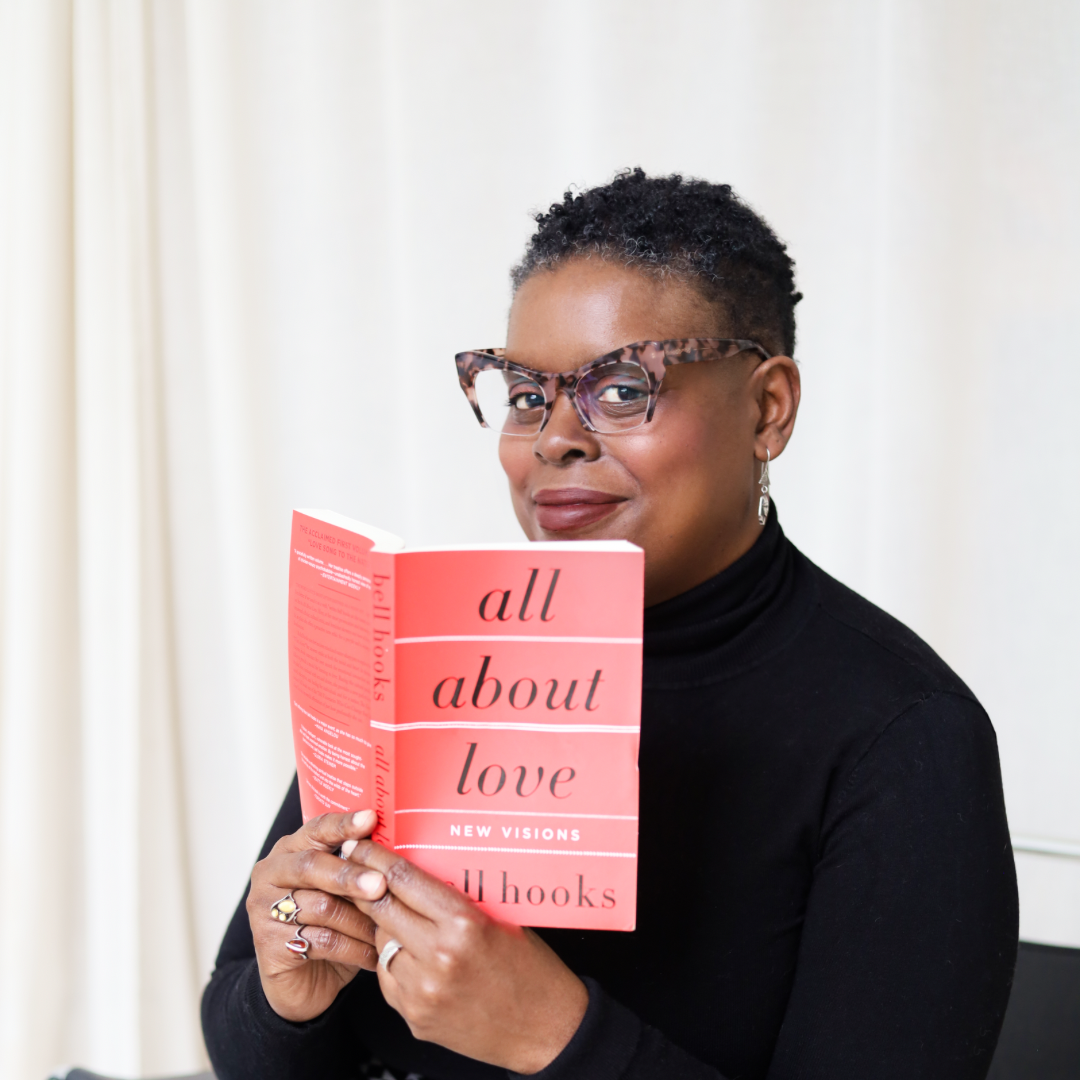
As a Black therapist, I am often asked what healing looks like for us, where it begins, what it requires, and whether it is truly possible within systems that continue to exploit, exhaust, and endanger Black life. Therapy can be a starting point. It can offer reflection, language, and nervous system support. But therapy alone is not liberation.
Black futures require more than insight. They require practice, particularly the practice of love, rest, and imagination.
bell hooks reminds us in All About Love that love is not an abstract ideal or a feeling that arrives on its own. Love, she writes, is an action. A practice rooted in care, commitment, trust, responsibility, respect, and knowledge. This framing is essential when we talk about Black healing, because many of us were never taught what love actually looks like in practice, only what we were expected to endure in its name.
Therapy as a Beginning, Not the End
Therapy can be one of the first places where Black people are invited to tell the truth about their inner lives without being managed, corrected, or dismissed. It can help us name how oppression lives in the body: as hypervigilance, emotional constriction, chronic fatigue, or grief that never had permission to surface.
This matters. Awareness matters. Regulation matters.
But hooks cautions us against confusing insight with transformation. Knowing something intellectually does not automatically change how we live or relate. Therapy can help us understand our patterns, but love-as hooks defines it-must be practiced. And practice requires relationship.
Black liberation cannot rest solely on individual healing inside a collective wound.
Learning What Love Is – and What It Is Not
In All About Love, hooks writes that many people grow up in families where love is confused with domination, obligation, or endurance. This resonates deeply in Black communities, where survival often required silence, over-functioning, and self-sacrifice.
As a result, many of us learned that love looks like:
- Staying when harm is present
- Minimizing our needs
- Confusing loyalty with safety
- Believing care must be earned through suffering
hooks is clear: this is not love.
Part of Black healing is learning-often for the first time-what love is not, so that we can begin to practice what love actually requires. Therapy can support this unlearning, but collective spaces allow us to experiment. To practice boundaries without punishment. To practice accountability without abandonment. To practice care that does not demand self-erasure.
Love, as hooks teaches, is incompatible with domination. That truth alone challenges the foundations of many oppressive systems.
Rest as a Loving Practice
Tricia Hersey’s Rest Is Resistance extends hooks’ work in a powerful way. If love is a practice rooted in care and responsibility, then rest becomes one of its most radical expressions.
hooks writes about a culture that glorifies work while neglecting care. For Black people, this is intensified by a history where our bodies were valued primarily for their labor. Rest, then, is not just personal, it is political. It is a refusal to accept productivity as the measure of worth.
Therapy may help someone recognize burnout. But collective rest teaches us something deeper: that we are worthy of care even when nothing is being produced. That slowing down is not failure. That tending to the body is a form of resistance.
Rest is love enacted at the level of the nervous system.
Dreaming as a Discipline
Octavia Butler understood that imagination is not a luxury-it is a discipline. Her work reminds us that oppressive systems depend on limiting what we believe is possible. Trauma narrows our capacity to imagine. Survival mode keeps us focused on what is immediately threatening.
hooks believed deeply in the power of vision. She wrote about love as a force that moves us toward justice, not just personal fulfillment. Dreaming of Black futures is an act of love because it insists that our lives are worthy of more than endurance.
Therapy can help widen our internal world. Collective dreaming expands it further. When Black people gather to imagine-not just to process pain, but to envision care, joy, safety, and autonomy-we participate in future-making.
Dreaming is not naïve. It is strategic.
Collective Healing as the Ground of Black Futures
bell hooks reminds us that love cannot thrive in isolation. It requires community. Shared accountability. Shared responsibility.
Black futures are not built through individual wellness alone. They are built through collective practices of care-spaces where we learn how to love without domination, rest without guilt, and imagine without apology. Therapy can help us become resourced enough to participate in these spaces. It can help us recognize where fear or internalized oppression limits our capacity to receive love.
But the work does not end in the therapy room.
When Black people are free-free to rest, to love, to imagine, to live fully-we all benefit. Systems rooted in domination harm everyone, even as they privilege some. Liberation is not a scarcity project.
As bell hooks teaches us, love is the foundation of justice.
And Black futures are built wherever we choose to practice love – not as a feeling, but as a way of life.
Don’t know where to start? Here is our reading list:
Parable of the Sower Octavia E. Butler
My grandmother’s Hands Resmaa Menakem
Rest is resistance Tricia Hersey